A global leader in the design, manufacture and distribution of infrastructure access solutions — ductile iron, steel and composite covers, gratings and drainage systems.
About EJ
Global reach, local delivery.
EJ operates 10 production sites, 50 sales offices and 31 logistics depots, serving more than 140 countries across sectors such as transport, airports, utilities, telecoms and water networks.
EJ recently acquired UK-based Swarm Water Management, adding the Swarm Aqua® linear slot drainage range to its water management portfolio. As EJ's partner, DND Construction Technicals (FZE) supplies Swarm Aqua® for projects that need high-performance surface water drainage, from pedestrian streetscapes to heavy-duty industrial and airport environments.
10
Production sites
50
Sales offices
31
Logistics depots
140+
Countries served
Featured Solution
Swarm Aqua® Linear Slot Drainage
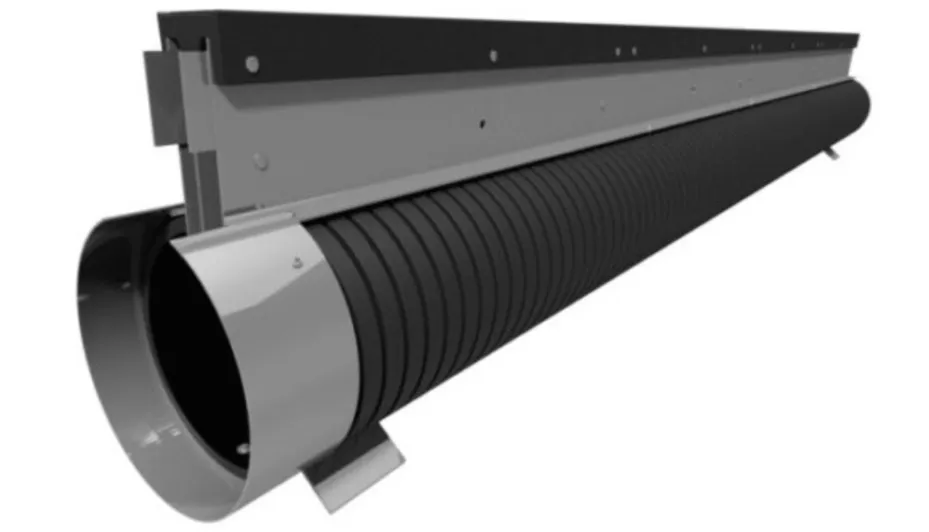
A hybrid surface water drainage system. Swarm Aqua® combines a recycled HDPE twin-wall conduit with steel walls and a precision-engineered ductile iron top, giving strength, rigidity and a lighter weight that makes installation easier.
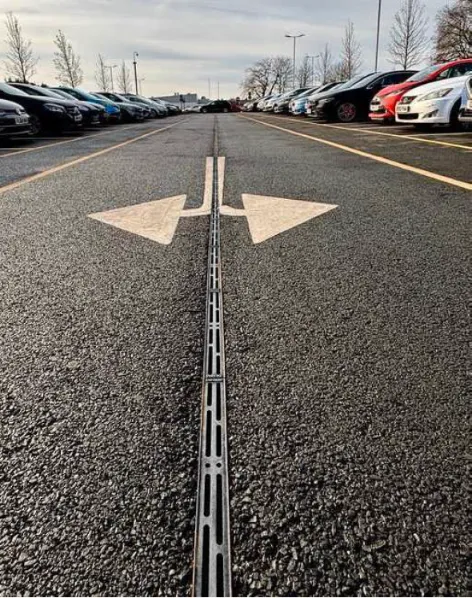
The slim slotted top is discreet and pedestrian friendly. Twin offset slots reduce the risk of debris bridging across the opening, and the smooth-bore conduit helps water flow efficiently.
Discreet line
Swarm Aqua® D400 Paving
Designed for city centres and paved areas, where a discreet drainage line is needed.
City centres · Paved areas
Up to 400kN
Swarm Aqua® D400
Suits car parks, driveways and highways, where loads of up to 400kN require a robust iron top.
Car parks · Driveways · Highways
Up to 900kN
Swarm Aqua® F900
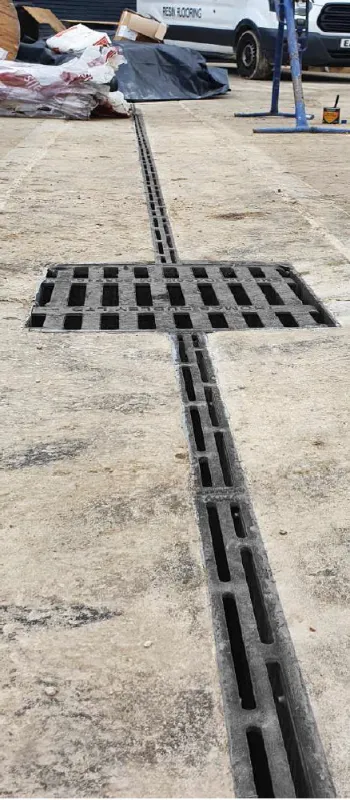
Built for extreme loads of up to 900kN, such as industrial ports and airports where vehicles with solid wheels make constant turning movements. It also needs less reinforcement than many systems at this load class.
Industrial ports · Airports
Channel diameters from 150mm to 600mm
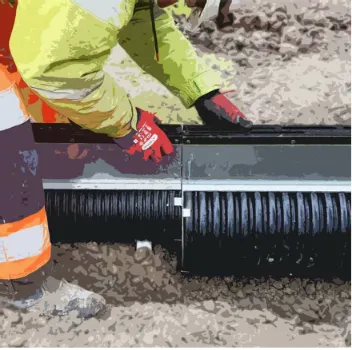
Each 2m section has an interlocking steel collar, an integrated throat spacer and stabilising feet, so runs connect quickly and stay straight during installation
Accessories include end caps, transition pieces for stepped-fall runs, chamber connectors and combined access/outlet boxes for inspection and maintenance
Designed to be self-cleansing in operation — cleaned by pressure washer, slot drain tool or jetting through the access boxes
Design Support
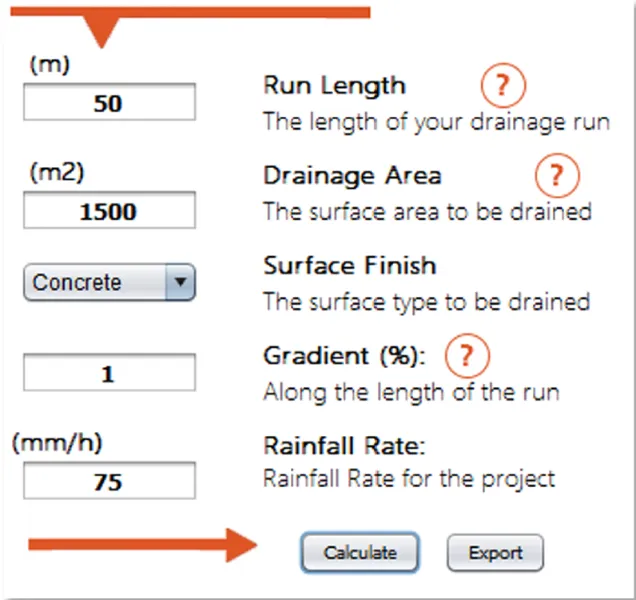
AquaCALC® Design Software
To make sure every Swarm Aqua® run is correctly sized, EJ provides AquaCALC®, a free design tool, along with a full technical design and value engineering service.
AquaCALC® works out how much water a channel must handle — the project's rainfall rate multiplied by the catchment area and by a permeability factor for the surface finish, ranging from 100% for concrete to 50% for gravel.
Safety margin
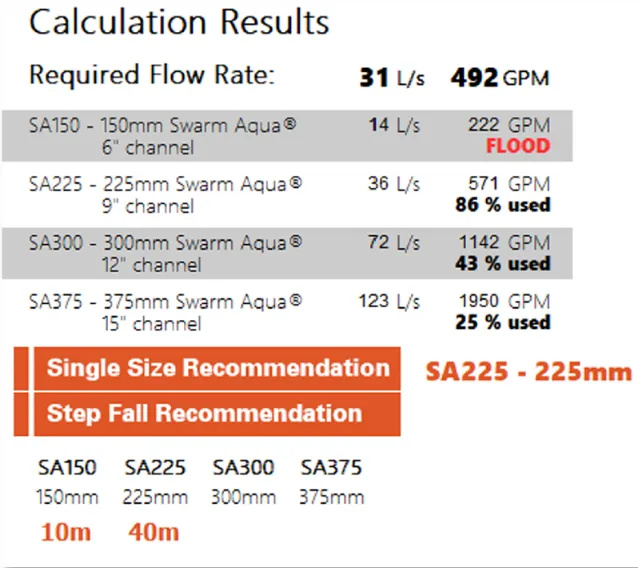
A 10% safety margin is then added to the required flow rate.
Worst-case model
The software models the worst-case scenario, with all flow starting from the high end of the channel, and applies Manning's equation — the standard formula for open channel flow — to every possible configuration of the run.
Sized result
The result is either a single channel size or a stepped-fall recommendation that combines different channel sizes along the run, for the most efficient and economical layout.
Want to explore EJ's full range of flood protection and flow control solutions?